R&D Tax Credits:
A Business Guide
What Is an R&D Tax Credit?
An R&D tax credit is a federal tax incentive that allows eligible U.S. businesses to reduce their tax liability based on qualified research expenses.
The principle is straightforward: your business invests in developing or improving products, processes, software, formulas, techniques, or technologies, and the U.S. tax system may recognize a portion of that investment through a credit under Internal Revenue Code Section 41. The purpose is to reduce the cost of taking technical risks and encourage businesses to invest in innovation that drives productivity, competitiveness, and long-term economic growth.
The United States has operated its federal research credit for decades. Today, businesses claim the credit by calculating qualifying research expenses and reporting the credit on IRS Form 6765, Credit for Increasing Research Activities.
To illustrate the potential: a U.S. company with $2 million in qualified research expenses may be able to generate a meaningful federal tax credit, depending on its historical research spending, chosen calculation method, and applicable limitations. Unlike a flat grant or automatic reimbursement, the U.S. R&D credit is calculated under specific IRC rules and requires contemporaneous support for the activities and expenses claimed.
The benefit is not trivial. For businesses doing meaningful technical work in the United States, the R&D tax credit can represent a material annual tax benefit and a valuable way to reinvest in continued innovation.

What Are the Key Details of the Credit?
The U.S. R&D tax credit is not calculated using a single flat rate.
Under Internal Revenue Code Section 41, the credit is generally determined by comparing a company’s current-year qualified research expenses to a historical base amount. The result depends on the company’s research spending profile, prior-year qualified research expenses, gross receipts history, and the calculation method used. Most businesses calculate the federal credit using one of two methods:
The applicable method can materially affect the size of the credit. For some companies, particularly those with limited research history or changing revenue patterns, the Alternative Simplified Credit may provide a more practical calculation.
For others, the Regular Credit Method may produce a larger benefit. In practice, the effective benefit is often lower than the headline statutory percentage because the credit is based on incremental research spending rather than total qualified research expenses. A detailed calculation is required to determine the available credit for each tax year.
What Counts as Qualifying R&D?
For U.S. federal R&D tax credit purposes, an activity does not qualify simply because it is innovative, technical, or commercially important. Each project, or business component, must satisfy the statutory requirements for “qualified research” under IRC Section 41. In practice, this is commonly referred to as the four-part test. For a project to qualify, it must generally meet the following conditions:
The activity must be aimed at developing or improving a product or process.
The work must rely on engineering, physical or biological science, or computer science principles.
The activity must involve a genuine technical uncertainty about whether the developers are capable or do not know the best method to achieve a goal.
Your team must have a process that is capable of testing alternatives evaluating approaches.
The common thread is resolving genuine scientific or technological uncertainty. Taxpayers must only be uncertain as to the capability of being able to reach a solution, not knowing the best method of solving the technical uncertainty, or appropriateness of the ultimate product design for the taxpayer’s product or process. An important consideration is that technical uncertainty is measured at the outset of the project. If a project has failures or setbacks along the way, then it stands to reason that there was some level of technical uncertainty.
This means the U.S. test is focused less on whether the work is generally “innovative” and more on whether the company faced technical uncertainty and undertook a structured process to resolve it. The analysis must be applied at the project (i.e. business component) level and supported with appropriate documentation.
Where Must the R&D Take Place?
Under IRC Section 41, research conducted outside the United States, Puerto Rico, or a U.S. possession is excluded from qualified research, even if the work otherwise involves technical uncertainty or experimentation. This means that wages, supplies, or contract research costs tied to offshore R&D activity generally cannot be included in the federal credit calculation.
Who Is Likely to Qualify?
The U.S. R&D tax credit is available to businesses across a wide range of sectors. The defining question is not what industry you are in, but whether your team is undertaking qualified research to resolve genuine technical uncertainty.
You do not need a formal R&D department, a laboratory, or a dedicated innovation team. Many valuable R&D credit claims are made by businesses carrying out development work as part of building, improving, or scaling their products, processes, software, formulas, techniques, inventions, or technologies, even if they do not describe that work internally as research and development.
In practice, companies may qualify where they are attempting to improve performance, reliability, functionality, or quality, and where the work involves a process of experimentation grounded in engineering, computer science, physical sciences, or biological sciences.
That means eligibility is often found in industries such as software, manufacturing, engineering, life sciences, food and beverage, energy, architecture, agriculture, and advanced materials. What matters is whether the underlying activities meet the U.S. qualified research rules, not whether the business operates in a traditionally “scientific” sector.
Common Qualifying Activities by Sector
Agriculture
Testing new feed formulations or nutrition schedules; using genomics, breeding data, or performance data to improve animal or crop traits; trialing new methods to improve yield, quality, health, or production efficiency.

Artificial Intelligence
Designing and training custom machine learning or NLP models; testing alternative model architectures, features, or training methods; embedding AI into larger software platforms where performance, accuracy, or scalability is uncertain.

Manufacturing
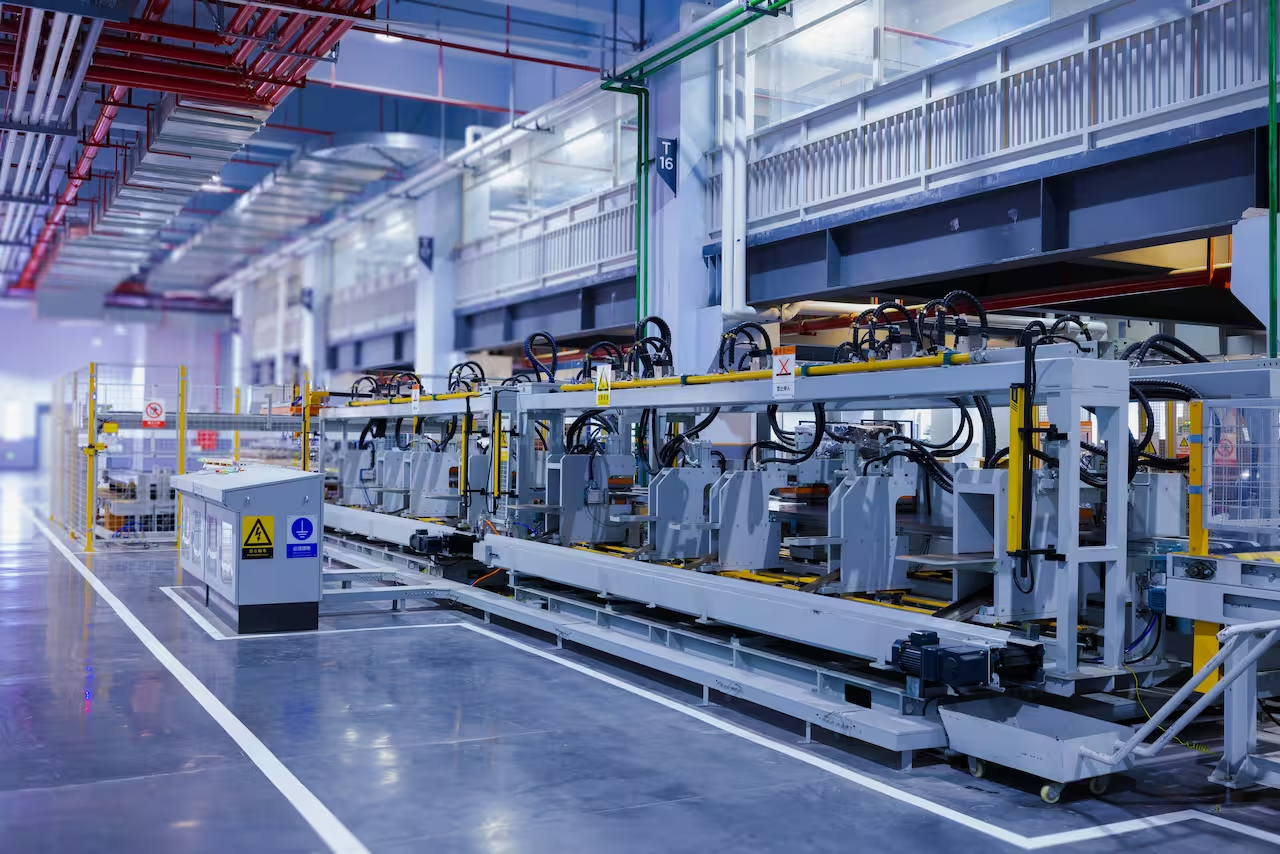
Designing and prototyping new components, assemblies, or finished goods; developing custom tooling, fixtures, molds, or production methods; integrating robotics, vision systems, or automated control logic into production workflows.
Metal Fabrication
Modifying designs to improve weight, strength, thermal performance, or manufacturability; testing welding techniques to reduce defects such as cracking, porosity, or undercut; evaluating alternative metals or alloys for strength, weldability, corrosion resistance, or cost.

SaaS
Developing new platform functionality or backend architecture; solving scalability, latency, uptime, or data-processing constraints; building or improving algorithms for search, matching, recommendations, automation, analytics, or workflow logic.

Cyber Security
Developing and testing intrusion detection systems, threat modeling frameworks, or vulnerability assessment protocols, improving encryption methods, access control architectures, or network segmentation strategies.

Biotech
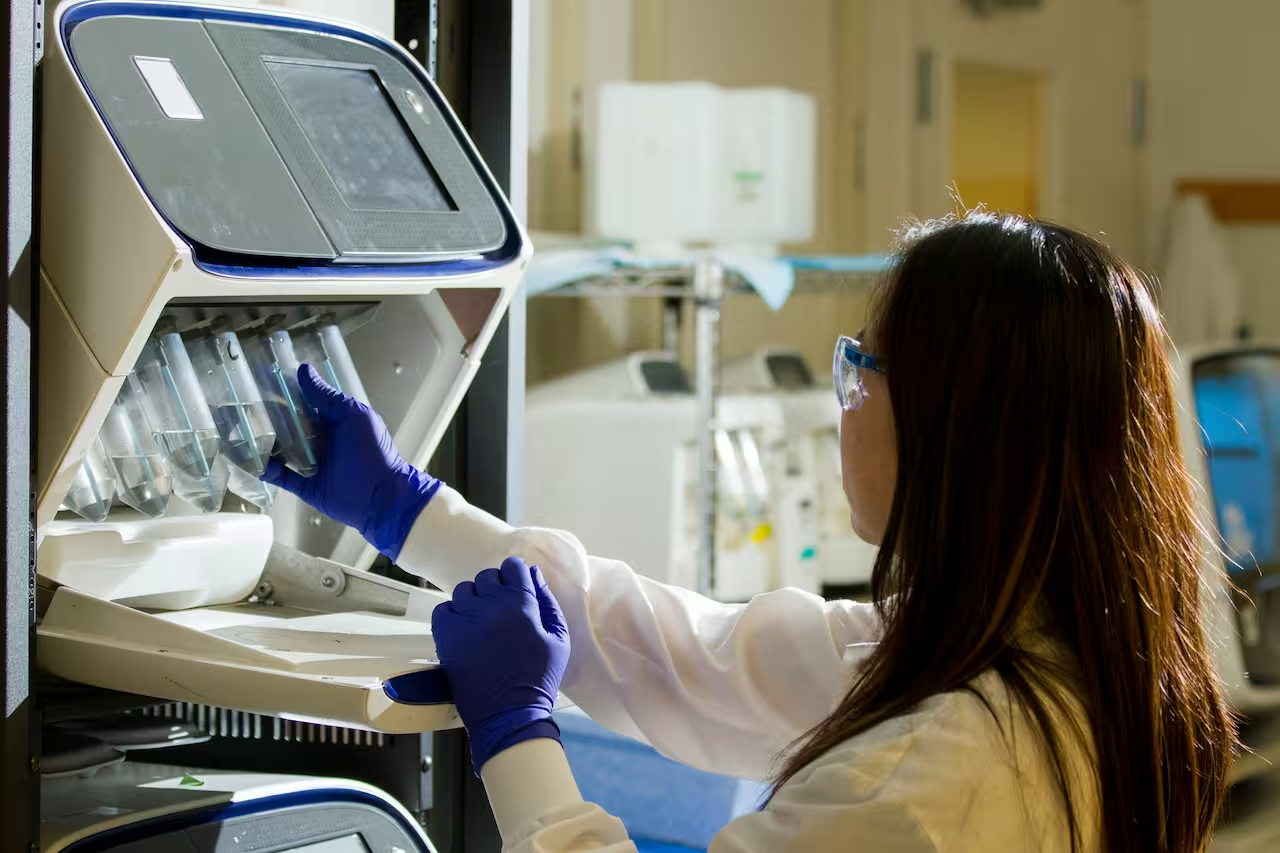
Conducting drug discovery or therapeutic development, developing new delivery mechanisms, experimenting with fermentation, purification, crystallization, cell therapy, or gene therapy processes, testing compounds, optimizing dosing or formulation strategies.
Cosmetics
Developing new formulations with specific skin feel, viscosity, stability, or shelf-life requirements; testing ingredient substitutions for preservatives, fragrances, colorants, or sensitizing compounds; experimenting with emulsifiers, rheology modifiers, active delivery systems, or manufacturing processes.

Aerospace
Designing or improving aircraft components, propulsion systems, or structural assemblies; testing alternative materials, geometries, or configurations to meet performance, weight, or certification requirements; developing embedded avionics software, flight control systems, or human-machine interfaces.

This list is illustrative. If your team is making technical decisions where the outcome is genuinely uncertain, it is worth having that work assessed.
What about businesses that do not see themselves as technology companies?
Many businesses assume they do not qualify because they are not a tech company or do not have an R&D team. The qualifying test does not ask what kind of company you are.
It asks whether specific activities resolve technical uncertainty. A logistics business building a proprietary routing system may qualify. For example, a farm testing new and improved feed rations may qualify for the credit if they are focused on improving the health of the animal. The nature of the underlying activity is what matters.
Documentation is the foundation of every claim.
The IRS requires documentation for R&D tax credit claims. The George v Commissioner case set expectations for what the expectations of what documentation is expected in order to qualify.
How RK Partners Can Help
RK Partners is a specialist R&D tax consultant firm with a long track record of helping businesses maximize the value of their R&D investment. After the three steps, we compile an audit-ready report for your CPA to file alongside your taxes or amends for prior years.
Technical Interviews
We meet with your key staff to identify every qualifying project and disqualify any that don’t meet IRS criteria.
Financial Review
Our team reviews your payroll, general ledger, and tax returns to calculate the full credit.
Compliance Review
A dedicated team with an impeccable IRS defense record reviews everything through our QA process.
What Our Clients Say
Our track record is built across more than 800 businesses.
They were really good to work with, and the process was relatively easy. It’s a specialized thing for sure, for a normal CPA this doesn’t fall under their umbrella. It was positive and definitely worth the time.

I had a key role in working with Sam and the team at RK Partners on behalf of Sydor Optics. There was some work involved, specifically in acquiring current and past data for analysis, but the ROI was well worth it!
Sydor Optics has never taken advantage of R&D credits because we are a custom build to print shop. After talking with Sam, it turns out we do R&D activities every day. Whether it’s making our process more efficient through DOEs, trying out to new consumables, or our daily DFM meeting, it all counted! Sam and his team are great and easy; I highly encourage a call with them. Traditional CPAs only know so much, RK knows the tax code inside and out.
RK Partners did a great job of finding all qualifying R&D work in my business and documenting it professionally. We were also able to find current work that will qualify for our claim next year, so I look forward to working with them in the future! I would recommend using RK Partners to look into your current process, they have very specialist people over there that will make sure you get the best possible benefit within the regulations.

I appreciate the work that RK did to help me identify and work through my farm R&D tax credit. The team did a great job of helping me identify the information they needed and putting it all together.
Great communication through the whole process which helped me have confidence in the process.
.avif)
We have been working with RK Partners for a few years now on the R&D Tax Credits, having worked with another specialist provider before. One thing that stood out is RK’s knowledge of the agricultural space: they understand the work that we do and are clearly experts in the sector.
The result is that we have had a more substantial benefit year on year, which has been very helpful! They have also been great at working with our CPA throughout the process – saves us time, for sure! I would recommend the team at RK to anyone in the poultry sector looking to do an R&D Tax Credit claim!
.avif)
A successful partnership from the first phone call... We have worked with RK Partners for 2 years on our R&D Tax Credit Analysis.
Their professionalism, expertise, attention to detail and most importantly interpersonal skills made the entire process smooth and successful. It has been a real pleasure working with them and we look ahead to continued success together.
.avif)
We’ve been working with R&K Partners for over three years on our R&D tax credit analysis, and the experience has been consistently excellent, hands on, and professional. As a tech startup, it’s rare to find partners who combine deep technical expertise with world-class responsiveness; RK delivers on all fronts.
With recent changes in legislation, R&D tax credits are more important than ever, and having a trusted, knowledgeable team in your corner makes all the difference. I highly recommend them to any enterprise: from startups to bonafide enterprises.

BioXtek has partnered with RK Partners for several years to manage our R&D tax credit claims, and their expertise has been instrumental in our success. As a startup that has scaled significantly, we’ve relied on RK Partners to establish and maintain a robust, compliant process for capturing R&D tax credits.
Their proactive guidance ensured we implemented effective systems early on, allowing us to maximize eligible credits while seamlessly adapting to our growth. RK Partners’ deep knowledge, reliability, and commitment to our success make them an invaluable partner. We highly recommend their services to any organization seeking to optimize their R&D tax credit claims with confidence and efficiency.

FREQUENTLY
ASKED QUESTIONS
Not necessarily. A business does not need to be profitable to generate an R&D tax credit, but the way the benefit is used depends on the company’s tax position. For profitable companies, the credit can generally be used to reduce federal income tax liability.
For certain qualified small businesses, the credit may also be used to offset a portion of employer payroll taxes, which can make the benefit valuable even before the company is generating taxable income. This is especially important for early-stage and growth-stage businesses.
A company investing heavily in product development, software, engineering, or technical innovation may be able to benefit from the R&D credit even if it is not yet profitable, provided it meets the applicable requirements and properly documents the qualified activities and expenses.
For federal purposes, qualifying contract research expenses are generally limited to 65% of amounts paid or incurred for qualified research performed on behalf of the taxpayer. The work must still meet the IRC Section 41 requirements, and the research generally must be performed in the United States.
How the arrangement is structured and documented matters. Contracts should clearly address who bears the financial risk of the work, who retains rights to the research results, where the work is performed, and what technical activities the external party is actually performing. This is particularly important for companies using offshore development teams, related-party service providers, or outsourced engineering resources.
The costs may be commercially important, but they are not automatically eligible for the U.S. R&D credit.
Yes. The qualifying test does not require a formal R&D function. Many of the most significant claims are made by businesses that have never described their work as R&D. If your team is solving technical problems where the outcome is uncertain, there may well be a claim.
Where records are in good order, the process can often be completed efficiently. Businesses that identify qualifying projects early, track time and expenses consistently, and document technical uncertainty as work occurs are generally in a stronger position to prepare a timely, defensible claim.
The earlier the process begins, the easier it is to capture the right evidence and avoid relying on incomplete year-end reconstruction.